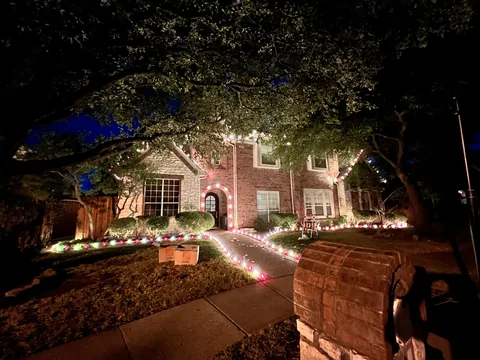
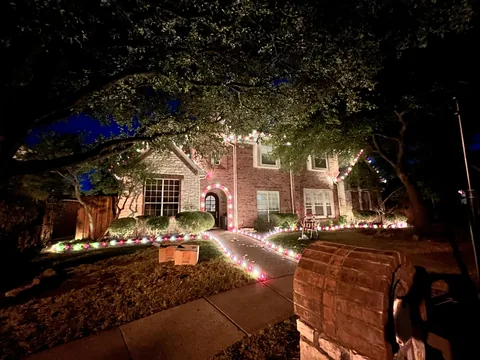
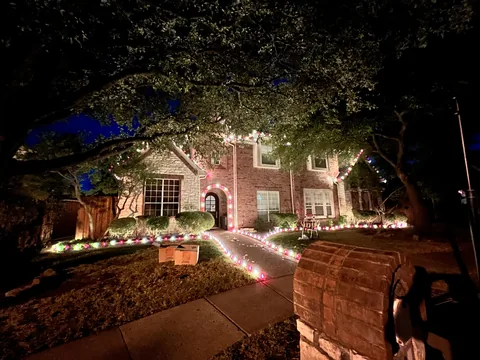
Why color choice matters more than you think
Christmas light colors create more than visual decoration — they communicate. Studies in color psychology show that exterior holiday lighting colors affect how viewers perceive the home, the homeowner's taste level, and the neighborhood character. The choice of warm-white vs. multicolor, traditional red-and-green vs. modern blue-and-silver, sends signals about your aesthetic priorities. Understanding what each color communicates helps you make intentional choices that match your home's architecture and your desired image.
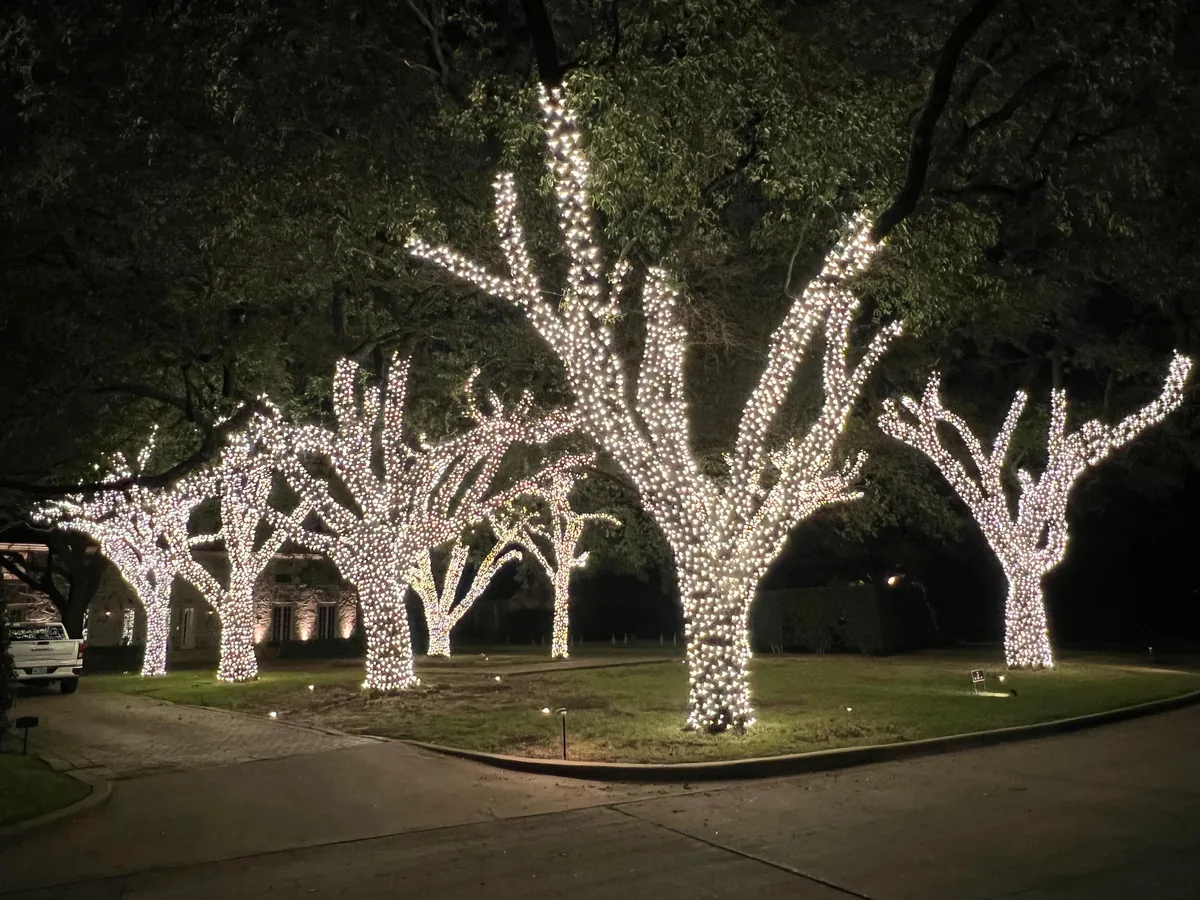
Warm white reads as elegant and timeless; cool white feels crisp and modern; multicolor signals fun and family. Pick one mood and commit — a consistent palette always looks more expensive than a mix.
Warm white: classic luxury
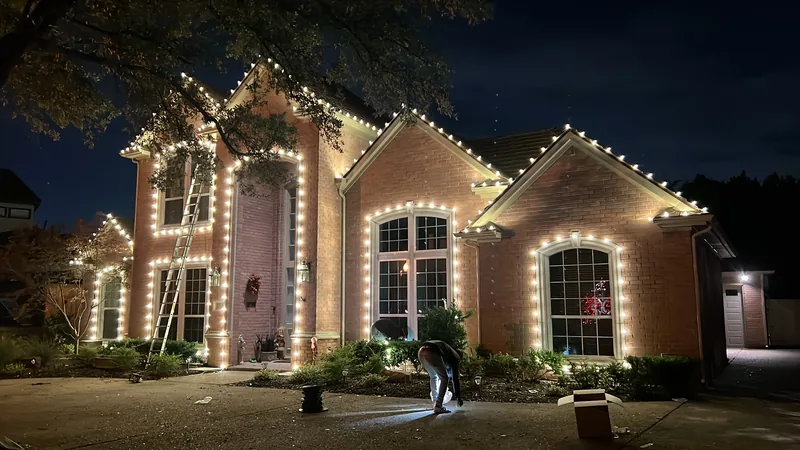
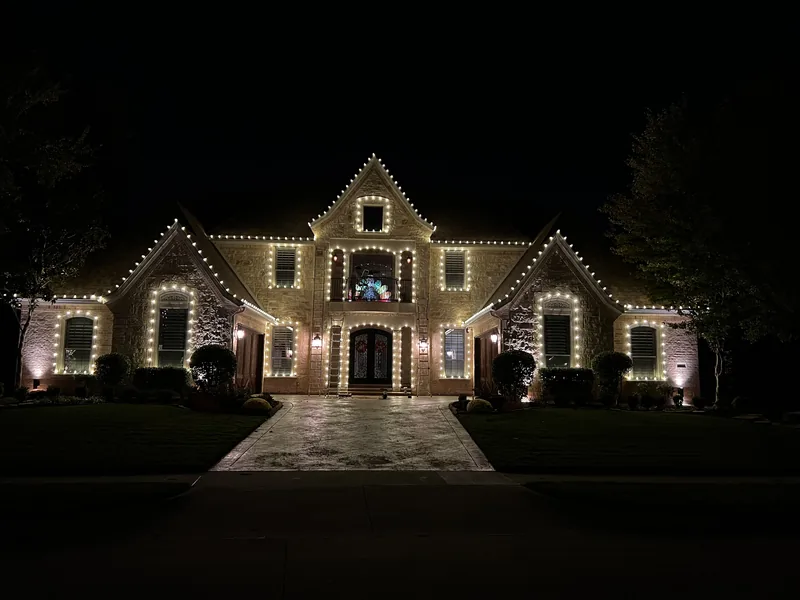
Warm white (2700K-3000K color temperature) is the most-chosen color for luxury DFW homes. It communicates: sophistication, classical taste, attention to detail, traditional values, warmth and welcome. The color complements virtually any architectural style — Tudor revivals look beautiful in warm white, Mediterranean estates take on a Italian-villa quality, modern transitional homes gain warmth, traditional brick colonials look magazine-perfect. Warm white is what you see on premium hotels and restaurants. It's the safe, beautiful choice that never goes out of style. Highland Park, Park Cities, and Vaquero Club residents overwhelmingly choose warm white.
Cool white: modern sophistication
Cool white (4000K-5000K color temperature) has a slight blue cast that creates a sharper, more contemporary look. It communicates: modern aesthetic, precise installation, modern taste. Cool white pairs especially well with contemporary architecture (Frisco luxury new construction, modern Dallas homes, contemporary Westlake estates) where the cleaner light highlights architectural lines and recent design language. Cool white is less universally flattering — it can make traditional homes look 'wrong' the way cool-white bulbs look harsh in a Tudor revival. Best for modern construction; avoid for historic or traditional architecture.
Red and green: classic Christmas tradition
The red-and-green combination is the most recognizable Christmas color scheme — and it's making a comeback after a decade of warm-white dominance. Red-and-green communicates: family-focused, traditional, joyful, child-friendly, openly celebrating Christmas. The combination has historical roots (holly berries and leaves) and immediate emotional impact. Best for family-oriented suburban homes (Plano, McKinney, Frisco family neighborhoods). The combination requires careful balance — too much red looks aggressive, too much green looks unbalanced. Professional installers know the right ratios. Recently popular in The Colony and Carrollton family neighborhoods.
Multicolor: maximum celebration
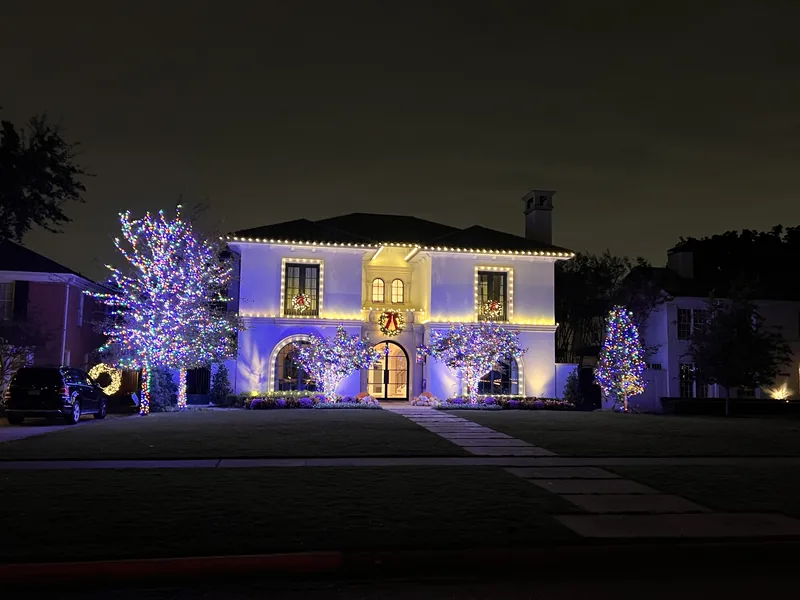
Multicolor displays (red-green-blue-yellow-orange combinations) communicate: festive, fun, family-friendly, openly celebratory, child-oriented. The classic 'C9 multicolor' look is what most people imagine when they think of Christmas lights from their childhood. Multicolor creates the most visual energy and grabs attention from distance. Best for: family homes with children, neighborhoods that participate in Christmas light tours, homes with mature trees that look standout wrapped in multicolor. Popular in many Plano, McKinney, and Allen family neighborhoods. Avoid for: high-end estates where the look may read as less sophisticated, historic homes where it conflicts with architecture.
Blue and silver: elegant modernism
Blue-and-silver displays communicate: contemporary luxury, beautifully lit display theme, modern sophistication, less traditional Christmas. Blue creates a cool, almost nautical or winter-themed feeling that contrasts with classic warm holiday tones. The color works well for: modern homes, lake-front properties (Lake Lewisville, Lake Ray Hubbard), winter-themed displays. The challenge: blue alone reads as somber or even sad. Always pair with silver or cool-white accents for balance. Stewart Peninsula and Lake Highlands lake-view homes often use this scheme.
Gold and warm white: high-end
Gold (technically a deep amber-yellow color temperature around 2200K) combined with warm white creates the most luxurious holiday display possible. Gold communicates: ultimate sophistication, royal aesthetic, ultra-premium taste. The combination is favored by high-end properties — Westlake Vaquero Club estates, Highland Park mansion-class properties, Lucas estate properties. The look references high-end European architectural lighting traditions. Best for: $3M+ estate properties where the most subtle aesthetic distinction matters. Avoid for: mainstream homes where it may read as trying too hard.
Mixing colors for sophisticated displays
The best Christmas light designs often combine 2-3 colors strategically rather than picking a single color. Common professional combinations: warm white on rooflines + gold on tree wrapping (high-end); warm white on house + red on wreaths and trim (traditional with accent); cool white on rooflines + blue accents on landscape (modern winter theme); multicolor on trees + warm white on house (festive but anchored). Mixing requires design expertise — random color combinations often look chaotic. Professional installers know which combinations work and in what ratios.
What your neighborhood expects
Christmas light color choices often follow neighborhood conventions. Highland Park, University Park, Preston Hollow: predominantly warm white. Frisco luxury new construction (Stonebriar, Phillips Creek Ranch): warm white with some warm white + gold luxury accents. Plano family neighborhoods: more variety; warm white, red-green, multicolor all common. McKinney established neighborhoods: traditional warm white or red-green. Allen, Lucas, Parker estate areas: warm white predominantly, some gold accents at high-end. Going dramatically against neighborhood convention can look like you don't understand the area. Following convention can look unimaginative. The best approach: respect neighborhood character while finding your own subtle distinction within it.
From single-story rooflines to tall two-story estates — every home professionally measured, installed, and taken down by our insured crews.
Frequently asked questions
What color Christmas lights are most popular in luxury Highland Park homes?
Warm white (2700K-3000K) dominates luxury Highland Park homes — it complements the historic Tudor revival, Mediterranean, and Georgian architecture while communicating classic sophistication. Some high-end properties add gold accents on tree wrapping.
Should I use warm white or cool white Christmas lights?
Warm white (yellow-tinted, 2700K-3000K) works on virtually any architecture and looks traditional/luxurious. Cool white (blue-tinted, 4000K-5000K) suits modern homes but can look harsh on traditional architecture. Warm white is the safer choice for most DFW homes.
Are multicolor Christmas lights still in style?
Yes — multicolor C9 LED displays are seeing a resurgence after a decade of warm-white dominance. Multicolor works best for family-oriented neighborhoods, homes with mature trees for wrapping, and properties celebrating traditional Christmas. Less ideal for high-end estates.
Can I mix colors in my Christmas light display?
Yes — and the best displays often do. Common pro combinations: warm white house + gold tree wrapping (luxury), warm white house + red wreath accents (traditional), cool white house + blue landscape (modern). Random color mixing looks chaotic — professional installers know which combinations work.
What do different Christmas light colors symbolize?
Warm white: traditional luxury, sophistication. Cool white: modern, architectural. Red-green: family, traditional Christmas. Multicolor: festive, child-friendly. Blue-silver: beautifully lit display, modern. Gold: high-end, royal aesthetic. Each color sends different emotional signals to viewers.
Which Christmas light color shows up best from far away?
Cool white and bright multicolor displays show up best from distance because they have more visual contrast against night sky. Warm white reads more subtly and intimately from close distances. For homes meant to be admired from across the street or by passing cars, cool white or multicolor has more curb impact.
Ready for your custom DFW holiday lighting?
15+ years experience · 1,000+ DFW homes · 4.9★ Google rated · fully insured
The difference is in the details.
Three things separate professional luxury Christmas light installation from amateur work: materials, craftsmanship, and service relationship. Materials matter because commercial-grade C9 LED bulbs with sealed gaskets and polycarbonate shells last 10-15+ years compared to 2-3 seasons for big-box residential strands. The visible difference at the curb is significant — commercial-grade reads as crisp and elegant; residential-grade reads as fuzzy and inconsistent. Over many years, the cost difference is more than recovered through reliability.
Craftsmanship is where amateur installations fail and professional installations excel. Custom-cut C9 LED strands fitted exactly to your home's rooflines — every gable, dormer, valley, and architectural detail — create the magazine-quality holiday display that template installations simply cannot match. Every bulb evenly spaced. Every line clean. Every transition smooth. The lights look like they were designed for your home specifically, because they were.
Service relationship is what transforms transactional installation into long-term partnership. Free in-season service calls when something fails. January takedown and year-round storage so you store nothing. Lifetime warranty on installed LEDs. Returning customer priority and locked pricing. Same crew returning year after year, building deep familiarity with your home. The difference between installing Christmas lights once and being part of a homeowner's annual holiday tradition is real, and it's the difference our 500+ DFW customers come back for year after year.
Three ways to get started today.
Phone or Text
Call or text us directly at (469) 970-2715. Real person, same-day response, no obligation. Often the fastest path to a detailed quote.
Call now →Email thechristmaslightsexperts@gmail.com with your address and brief description. We respond same-day with detailed itemized pricing.
Get a Fast Quote →Online Quote Form
Submit our online quote form with property details. Convenient for thorough information sharing. Same-day response guaranteed.
📋 Quote form →For a simple roofline question or you're planning a full multi-acre estate installation, we respond same-day with the information you need. No high-pressure sales, no obligation, no follow-up calls if you decide not to proceed. Just honest professional service — which is why 86% of our tracked 2024–25 customers booked us again for 2025–26.

Ready for a
professional display?
Tell us about your home and we'll respond same day with a custom design and quote — concierge service, zero hidden fees, no obligation.
Or call/text directly: (469) 970-2715
Ready to make your home unforgettable?
Free same-day quote. No obligation. We respond fast and treat your home like our own.
Ready for a flawless display?
We design, install, maintain, and take down custom Christmas lighting across Dallas, Plano, Frisco & DFW — fully insured, fully managed.
Get a Free Quote →