Why this matters: the unregulated industry problem
Unlike electricians, plumbers, or contractors, Christmas light installers don't need licenses in Texas. There's no state board overseeing the industry. No required certifications. No mandatory insurance. This means anyone can buy a ladder, register a domain name, and run Christmas light ads. Many homeowners learn this the hard way — paying for installations from operations that disappear after collecting deposits, leave damage to roofs, or never come back for takedown. Asking the right questions before signing protects you from joining their lists of regrets. Use them to vet any Christmas light installation company in DFW — including us.
Before you hire, confirm three things: are they insured, do they use commercial-grade LEDs you keep, and is the quote all-in with no service-call fees? Vague answers on any of these are a red flag.
Question 1: How long have you been in business — verifiably?
Anyone can claim 'years of experience.' Real businesses can prove it. Ask for verifiable evidence: Google Business Profile creation date, BBB profile age, customer references from 5+ years ago, photos from prior seasons with date metadata, Texas LLC registration dates. Companies that have been in DFW for 10+ years can produce mountains of evidence. Newer companies (which is fine — everyone starts somewhere) should be upfront about their tenure rather than vague.
Question 2: Are you insured? Can you show me the certificate?
Real Christmas light installation businesses carry general liability insurance ($1M+ recommended) and workers compensation. The certificate of insurance lists your property as covered during the work. Ask to see it before signing. If they can't produce one within 24 hours, walk away. If a worker falls off your roof and the installer has no insurance, the lawsuit comes after your homeowners policy — which most homeowners policies don't cover for contracted work.
Question 3: Are your crews employees or subcontractors?
Direct W-2 employees are background-checked, trained on company methodology, insured under company workers comp, and accountable to company standards. Subcontractors are independent contractors hired for the day with variable training, often working for multiple companies simultaneously, with their own insurance gaps. National franchise installers and seasonal operations frequently use subcontractors. Family-owned local installers typically use direct employees. Ask the question directly — and ask for verification (W-2 paystubs, branded uniforms, company-marked vehicles).
Question 4: What kind of lights do you actually install?
There's a massive quality range. Cheap residential mini lights from big-box stores: $5-15 per strand, last 2-3 seasons. Commercial-grade C9 LED: $30-50 per strand, last 10-15+ years. Custom-cut C9 LED installed to fit your specific home: premium pricing, premium results. Ask exactly what you're getting — by brand if possible. Ask whether strands are pre-made standard lengths or custom-cut to fit your home's specific rooflines. Cheaper installers use standardized lengths with extra cable bunched at corners — looks amateurish from the curb.
Question 5: Is takedown and storage included?
This is a major separator. Premium installers include January takedown and year-round storage at their facility — you don't store anything in your garage, you don't deal with January weather, the lights come back next season ready to install. Budget installers charge separately for takedown ($200-500 add-on) and leave you to store everything yourself. The 'all-inclusive' model is significantly more valuable but requires confirmed inclusion in the contract.
Question 6: What happens if a light goes out mid-season?
Premium installers provide free in-season service calls — if anything fails between Thanksgiving and New Year's, they come back to fix it at no charge. Budget installers charge $75-200 per service call. Some installers don't respond at all once installation is complete. Ask the question explicitly and get the answer in writing in the contract.
Question 7: How do you handle damage to my property?
Even with insurance, what's the process if a clip damages a gutter, a ladder dents siding, or a worker breaks a shingle? Real businesses have established processes — written incident reports, photo documentation, repair coordination with their insurance. Scammers have no process and may simply disappear. Ask: 'walk me through what happens if your crew accidentally damages my home.' Their answer reveals their professionalism.
Question 8: Can I see your reviews — specifically Google reviews?
Google reviews are nearly impossible to fake at scale. They're tied to real Google accounts, often with photos, and customers can mention specific identifying details (neighborhood, property type, year of service). Yelp and Facebook reviews can be more easily manipulated. BBB ratings are useful but limited. Ask for the direct link to their Google Business Profile and read at least 10 reviews. Look for: details about specific work, mention of follow-up service, multi-year repeat customer language, and how the company responds to any negative feedback.
Question 9: Do you have a written contract?
Real businesses have written contracts that specify: scope of work (exactly what's included), pricing (no 'plus materials' surprises), schedule (install and takedown dates), warranty terms, what's NOT included, payment terms, and cancellation policy. Verbal agreements have zero legal standing if there's a dispute. If an installer resists putting things in writing, walk away.
Question 10: What's your pricing model — and are there any hidden fees?
Premium installers provide detailed itemized quotes. Every line item — labor, materials, takedown, storage — is broken out. Total is the total. No 'plus tax,' no 'plus travel fee,' no surprise add-ons. Budget installers often quote low numbers then add fees: 'travel surcharge' for your area, 'difficulty fee' for steep roofs, 'material upcharge' for custom cuts. Ask explicitly: 'is this the total cost — yes or no? If yes, are you willing to put 'no additional fees' in writing?' Real businesses say yes immediately.
Bonus: red flags that should make you walk away immediately
Cash-only payment requirements. No physical business address (just a phone number and website). Cannot provide insurance certificate. Quote significantly below other local quotes (50%+ lower often means the installer is unlicensed, uninsured, or planning to disappear). Pressure tactics ('this price only good today,' 'we have limited spots'). No written contract offered. No Google reviews or all-positive reviews from accounts with no other reviews. Requests for full payment upfront. Any of these alone is a yellow flag. Two or more is a red flag. Walk away.
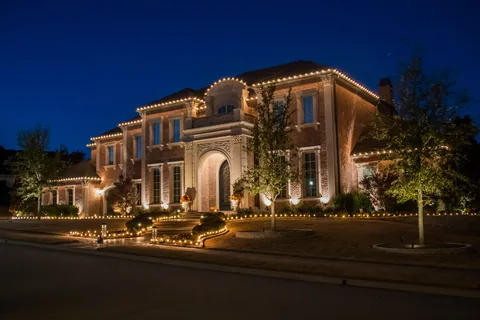
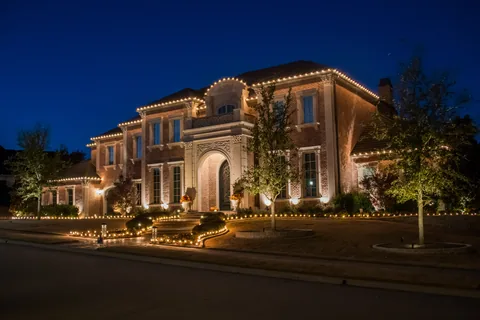
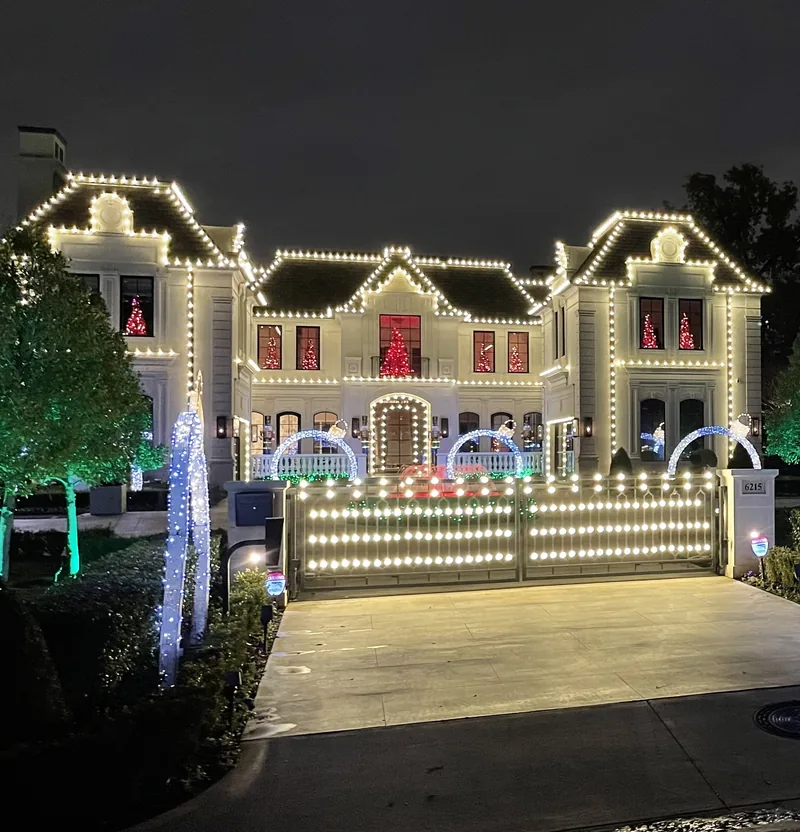
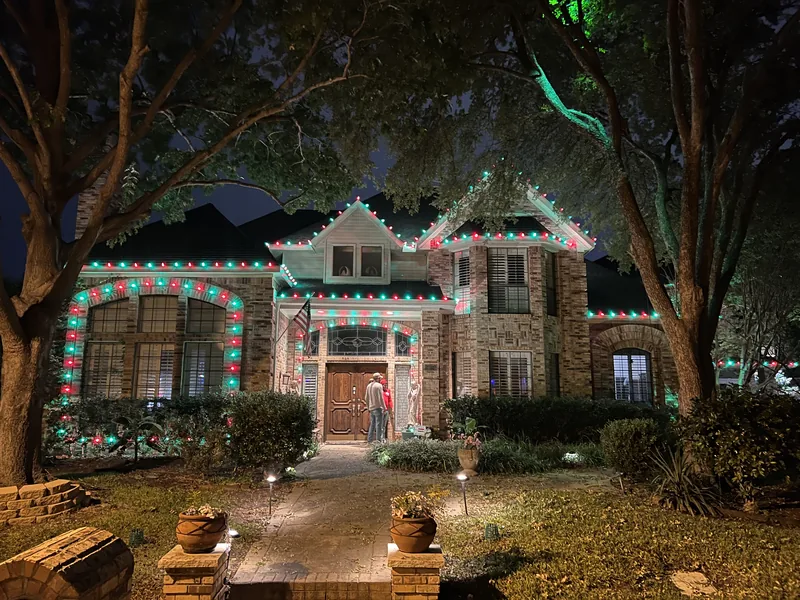
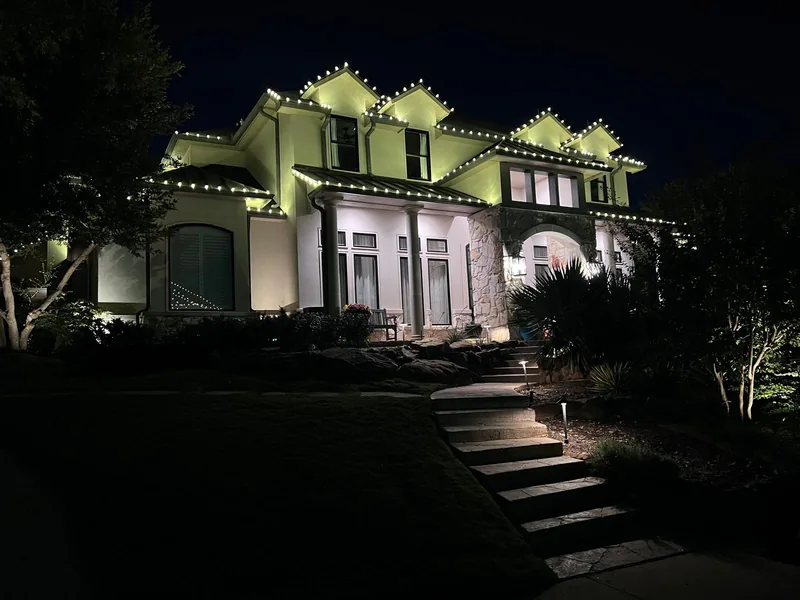
From single-story rooflines to tall two-story estates — every home professionally measured, installed, and taken down by our insured crews.
Frequently asked questions
How do I find a trusted Christmas light installer in DFW?
Look for: 5+ years in business with verifiable history, $1M+ general liability insurance, direct W-2 employees (not subcontractors), 36 Google reviews with detailed customer stories, written contracts with itemized pricing, and inclusive packages with takedown and storage. Always check Google Business Profile age and BBB rating.
Is Christmas light installation regulated in Texas?
No — Christmas light installers don't need state licenses in Texas. There's no required certification or mandatory insurance. This makes due-diligence questions critical before hiring. Always verify insurance and experience before signing contracts.
Should Christmas light installers be insured?
Yes — absolutely. Real businesses carry $1M+ general liability insurance plus workers compensation. Without insurance, if a worker falls off your roof, the lawsuit comes after your homeowners policy. Always ask for a certificate of insurance before signing.
How much should I expect to pay for Christmas light installation in DFW?
Standard homes typically run $1,200 to $2,500+. Larger luxury homes $750 to $2,500+. Estate-scale installations begin at $2,500+. Pricing varies by roofline complexity, tree wrapping scope, and total project size. Reputable installers provide detailed itemized quotes with no hidden fees.
What's the difference between W-2 employees and subcontractors?
W-2 employees are full-time direct hires — background-checked, trained on company methodology, insured under company workers comp, accountable to company standards. Subcontractors are independent contractors with variable training, separate insurance situations, and less direct accountability. Premium installers use direct employees.
Should I worry about cash-only Christmas light installers?
Yes — cash-only payment requirements are a major red flag. Legitimate businesses accept multiple payment methods and provide receipts. Cash-only operations often signal: avoiding tax reporting, lack of insurance, plan to disappear after payment, or operating outside legal business structure.
Ready for your custom DFW holiday lighting?
15+ years experience · 1,000+ DFW homes · 4.9★ Google rated · fully insured
The difference is in the details.
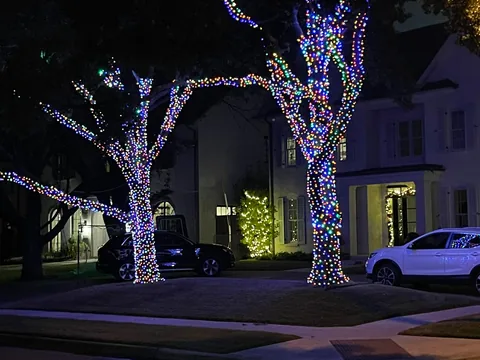
Three things separate professional luxury Christmas light installation from amateur work: materials, craftsmanship, and service relationship. Materials matter because commercial-grade C9 LED bulbs with sealed gaskets and polycarbonate shells last 10-15+ years compared to 2-3 seasons for big-box residential strands. The visible difference at the curb is significant — commercial-grade reads as crisp and elegant; residential-grade reads as fuzzy and inconsistent. Over many years, the cost difference is more than recovered through reliability.
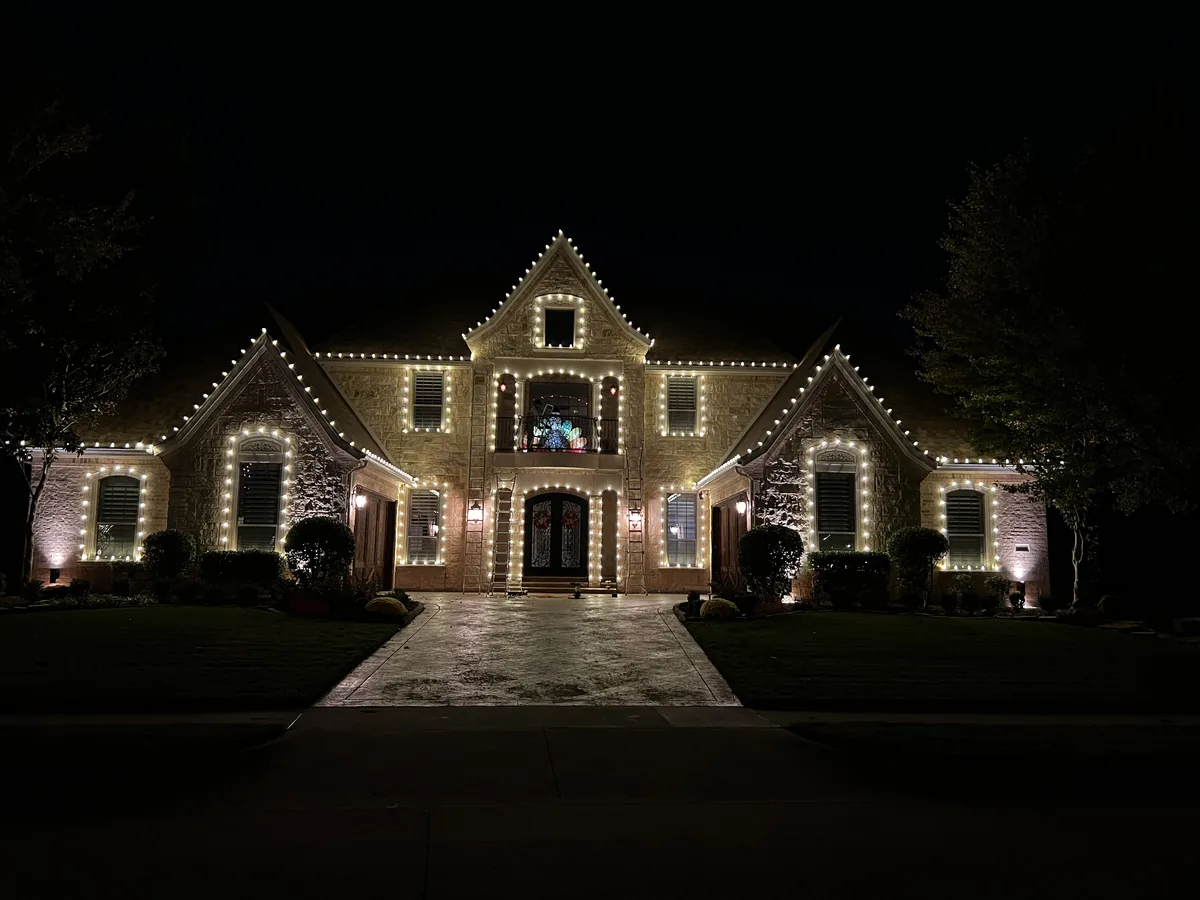
Craftsmanship is where amateur installations fail and professional installations excel. Custom-cut C9 LED strands fitted exactly to your home's rooflines — every gable, dormer, valley, and architectural detail — create the magazine-quality holiday display that template installations simply cannot match. Every bulb evenly spaced. Every line clean. Every transition smooth. The lights look like they were designed for your home specifically, because they were.
Service relationship is what transforms transactional installation into long-term partnership. Free in-season service calls when something fails. January takedown and year-round storage so you store nothing. Lifetime warranty on installed LEDs. Returning customer priority and locked pricing. Same crew returning year after year, building deep familiarity with your home. The difference between installing Christmas lights once and being part of a homeowner's annual holiday tradition is real, and it's the difference our 500+ DFW customers come back for year after year.
Three ways to get started today.
Phone or Text
Call or text us directly at (469) 970-2715. Real person, same-day response, no obligation. Often the fastest path to a detailed quote.
Call now →Email thechristmaslightsexperts@gmail.com with your address and brief description. We respond same-day with detailed itemized pricing.
Get a Fast Quote →Online Quote Form
Submit our online quote form with property details. Convenient for thorough information sharing. Same-day response guaranteed.
📋 Quote form →For a simple roofline question or you're planning a full multi-acre estate installation, we respond same-day with the information you need. No high-pressure sales, no obligation, no follow-up calls if you decide not to proceed. Just honest professional service — which is why 86% of our tracked 2024–25 customers booked us again for 2025–26.

Ready for a
professional display?
Tell us about your home and we'll respond same day with a custom design and quote — concierge service, zero hidden fees, no obligation.
Or call/text directly: (469) 970-2715
Ready to make your home unforgettable?
Free same-day quote. No obligation. We respond fast and treat your home like our own.
Ready for a flawless display?
We design, install, maintain, and take down custom Christmas lighting across Dallas, Plano, Frisco & DFW — fully insured, fully managed.
Get a Free Quote →